
“Congratulations on your promotion! You’re moving to Fort Bragg in 90 days.”
For military families, those words mean celebration. For military spouses, they often mean devastation.
Jessica had just gotten promoted to assistant manager at the boutique. Six months of proving herself. Finally making more than minimum wage. Building friendships. Settling in.
Now? Start over. Again.
This was her fourth move in seven years. Fourth time explaining the employment gap. Fourth time being the “military spouse” that hiring managers smiled at but never called back. Fourth time watching her career-track friends lap her while she reset to zero.
Until she stopped trying to fit into the traditional employment world and built something that moved with her.
Two years later, Jessica runs a six-figure high-ticket home decor dropshipping business. She’s been to three bases since launch. Her business hasn’t missed a beat. Last month, while her husband was deployed, she cleared $22,000 in profit from a laptop at the base Starbucks.
She’s not unique anymore. There’s a quiet revolution happening in military spouse communities: women (and men) who are done explaining employment gaps and started building portable empires instead.
Why Military Spouses Are the Ultimate Entrepreneurs (Even If They Don’t Know It Yet)
The military spouse life teaches skills that MBA programs can’t:
Extreme Adaptability: You’ve set up a functioning household in 72 hours across 6 states. Running a business through a PCS move? Child’s play by comparison.
Resource Optimization: You’ve made tight budgets work. You’ve found the best schools, doctors, and deal spots in every new city within a week. You’re a professional optimizer.
Community Building: You’ve built friend networks from scratch every 18-24 months. Customer community building? You’ve been training for it without knowing it.
Crisis Management: Spouse deployed, kid sick, car broken, you handled it. Business crisis? You’ve survived worse Tuesdays.
Self-Reliance: You’ve learned to solve problems alone because help is literally on another continent. Entrepreneurship rewards exactly this mindset.
The traditional job market sees military spouses as liabilities. The entrepreneurship market sees you as battle-tested operators.
Why High-Ticket Dropshipping Is PCS-Proof
Here’s the brutal truth about most military spouse side hustles:
- MLMs: Lose your downline every PCS, start over
- Local services: Can’t take clients to the next base
- Traditional jobs: Quit every 18 months, permanent résumé damage
- Low-ticket ecommerce: Grinding for $3 profits per sale
High-ticket dropshipping? It’s designed for mobility:
No physical inventory = Nothing to pack in the moving truck
No local customer base = Serve customers nationwide from anywhere
No employees = No hiring/firing with every move
High margins = Fewer transactions for meaningful income
Automated systems = Runs while you’re managing PCS chaos
When Jessica got orders to move from Camp Pendleton to Fort Benning, her business logistics were simple:
- Update business address with suppliers (10 minutes)
- Forward Shopify admin email to new address (2 minutes)
- Keep selling
That’s it. No farewell tours with clients. No scrambling for new employment. The income stayed consistent through the entire transition.
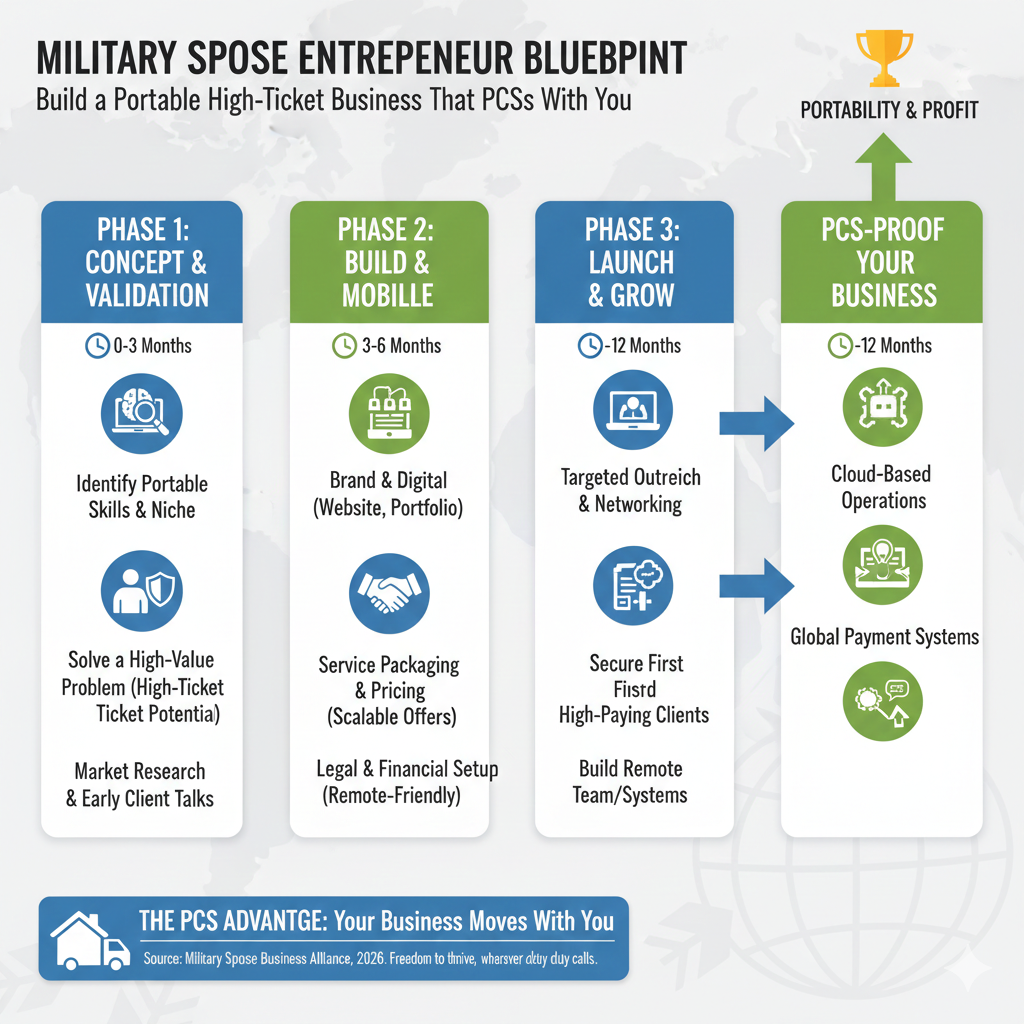
The Military Spouse Launch Timeline (PCS-Resistant Edition)
Phase 1: Pre-Launch (Weeks 1-4) – Build While You’re Stable
The best time to start is NOT during PCS. It’s during the calm period between moves.
Week 1-2: Niche Selection Through Military Lens
Don’t pick random products. Pick based on:
- What you understand (military families buy differently—capitalize on insider knowledge)
- What military communities need (home decor for frequent movers, deployment care packages, etc.)
- What has high-enough margins to matter (you need $500+ per sale minimum)
Jessica chose high-end home decor because she’d decorated 6 houses in 7 years. She knew what military spouses bought, what they avoided (heavy furniture that’s expensive to move), and what they splurged on (quality pieces that made each temporary house feel like home).
Her first 10 customers? Women in her base spouse group. Her next 50? Their referrals across 8 different bases.
Week 3: Brand Creation That Sounds Professional
This is where most military spouse businesses die before they start.
“JessicasHomeStuff.com” with a free Canva logo signals “side hustle.” When you’re asking someone to spend $1,500 on a piece of art, they need to see “established business.”
Military spouses often struggle with brand naming because the good names are taken, and the available ones sound amateurish. You’re competing with established retailers, so your brand can’t sound like a hobby.
This is where smart entrepreneurs leverage AI name generators—tools that combine your keywords (like “home,” “military,” “curated,” “modern”) with linguistic patterns to generate dozens of professional-sounding brand options you’d never think of on your own.
But generating names is just step one. Before you commit to anything, you need to verify it’s not going to confuse customers with similar existing businesses.
When you’re building a brand that needs to work across every base from Okinawa to Germany, you can’t have five other companies with nearly identical names. Professional founders check how many businesses share similar names before printing business cards—because discovering a conflict after you’ve built brand recognition costs months of momentum.
Week 4: Supplier Outreach (Military Advantage Unlocked)
Here’s your secret weapon: most suppliers love military spouse businesses.
Use this in your pitch:
“Hi [Name], I’m launching [Brand], serving military families with curated home decor solutions. As a military spouse who’s moved 6 times in 8 years, I understand the unique challenges our community faces with frequent relocations. I’m seeking partnerships with manufacturers who appreciate our demographic’s buying power and loyalty…”
Why does this work?
- Patriotic appeal (suppliers love supporting military families)
- Built-in market (640,000+ military spouses are your potential customers)
- Stable demographic (military families have reliable income)
Suppliers who might ghost a random dropshipper often respond enthusiastically to military spouse entrepreneurs.
Phase 2: Launch (Weeks 5-8) – Deploy Your Business
Week 5-6: Store Setup
Your Shopify store needs to look established, even on day one. High-ticket buyers judge instantly.
Invest in:
- Professional product descriptions (not copied from suppliers)
- High-quality product images
- About page that tells your military story (authenticity sells)
- Trust badges (Secure checkout, money-back guarantee)
- Contact info that looks permanent (not a Gmail address)
Week 7: Technical SEO Foundation
Here’s what most military spouse entrepreneurs skip and regret later: proper search engine setup.
Your store can be beautiful, but if Google can’t find it, you’re invisible. The first technical step is making sure search engines have a complete map of your site—every product, every page, every category.
There are sitemap generator tools that create the XML files search engines need, plus HTML versions for human visitors, in under 10 minutes. This isn’t optional technical jargon—it’s the difference between showing up on Google or being invisible.
Do this before you announce your launch. Your friends will share your link, but organic search traffic compounds over time. Starting with proper SEO infrastructure means month 12 looks different than month 1.
Week 8: Soft Launch to Military Community
Start where you have built-in trust: your base spouse groups.
Post something like:
“Hey, everyone! After our 4th PCS, I decided to build something that moves with me. I’m launching [Brand], offering [category] for military families. I’m starting with a soft launch to our community—use code MILSPOUSE for 15% off. Would love your feedback!”
Your first customers will be forgiving. They’ll tell you what’s confusing, what’s missing, and what works. This beta period is gold.
Phase 3: Scale (Months 3-6) – Build PCS-Proof Systems
Month 3: Automation Setup
Your goal: the business runs during PCS chaos without you.
Set up:
- Email automation (abandoned cart, order confirmations, follow-ups)
- Customer service templates (answer common questions fast)
- Supplier communication protocols (they can reach you even mid-move)
- Order processing systems (minimize manual work)
Jessica’s PCS from Pendleton to Benning happened during month 5. She processed 23 orders during moving week. Her customers had no idea she was literally living in a hotel.
Months 4-6: Military Network Effect
This is where military spouse businesses have an unfair advantage.
Military communities are incredibly tight-knit across bases. When a spouse at Camp Lejeune buys your product and loves it, she tells her friend at Fort Hood. That friend tells someone at Ramstein. This spreads faster than traditional marketing.
Encourage this:
- Referral program: “Give 15%, Get 15%”
- Base-specific discount codes (makes each community feel special)
- Feature customer photos from different bases on social media
- Partner with military spouse influencers (they exist on every platform)
Phase 4: Deployment-Proof Operations (Month 6+)
When deployment orders come, your business can’t fall apart.
Pre-Deployment Prep:
- Batch content for 6+ months
- Set up auto-responders for customer service
- Create SOPs (Standard Operating Procedures) for everything
- Have backup people for emergencies (virtual assistant, family member)
Your business becomes your deployment sanity. When Jessica’s husband deployed to Korea for 12 months, her business gave her:
- Income (BAH doesn’t cover everything)
- Purpose (better than counting days until R&R)
- Community (customers and other military spouse entrepreneurs)
- Pride (she was building something, not just surviving)
The Money Math for Military Spouses
Let’s run realistic numbers:
Startup Investment:
- High-ticket dropshipping course: $2,500
- Shopify + essential apps: $500 (first 3 months)
- Professional branding: $1,000
- Initial marketing: $2,000
- Total: $6,000
This is probably less than you spent on your last PCS move.
Conservative Month 6 Projection:
- Product: Premium wall art ($800 retail)
- Cost: $500 (37.5% margin)
- Profit per sale: $300
- Monthly sales: 20 units
- Monthly profit: $6,000
That’s $6,000/month that PCSs with you. That follows you to Okinawa, Germany, or Twentynine Palms. That stays consistent whether your spouse is home or deployed.
Compare that to starting over at Target every time you move.
The Real ROI: Freedom from the Employment Gap Conversation
Money matters. But there’s something else.
The next time someone asks “So, what do you do?” you don’t have to mumble about “taking time off to support my spouse’s career.”
You say: “I run an ecommerce company specializing in [category].”
Watch their face change. You’re not “just a military spouse.” You’re an entrepreneur.
At the next PCS, you’re not begging hiring managers to overlook your gap. You’re focusing on your growing business.
When your spouse gets promoted, you’re celebrating without the sinking feeling about your own career.
That shift—from dependent to independent—changes everything.
The Military Spouse Entrepreneur Community
You’re not building alone.
There are thousands of military spouse entrepreneurs. Facebook groups like “Milspouse Entrepreneurs” (40K+ members). Instagram communities under #milspouseentrepreneur. Local groups on every base.
These aren’t just cheerleaders. They’re:
- Supplier recommendations when you PCS to a new region
- Logistics advice for international moves
- Customer swaps and cross-promotions
- Reality checks when you’re doubting yourself
- Proof that this actually works
When you’re at Fort Hood and need advice on shipping to APO addresses, someone at Fort Bragg has already solved it. When you’re PCSing to Germany and worried about business logistics, someone’s done it successfully and will tell you how.
The 90-Day Challenge for Military Spouses
Here’s the reality: reading this blog won’t change your situation. Action will.
You have two paths:
Path 1: Six months from now, you’re explaining another employment gap to another skeptical hiring manager.
Path 2: Six months from now, you’re running a profitable business that survives PCS moves, deployments, and the chaos of military life.
The startup cost is less than a PCS move. The skills required are ones you already have. The timeline fits between moves. The business model is designed for mobility.
Your severance package from Corporate America doesn’t exist. But you have something better: the ability to build something that can’t be taken away by orders, layoffs, or relocations.
The question is whether you’ll start before the next PCS, or keep waiting for the “perfect time” that never comes in military life.
Final Word: You’re Already Qualified
Every objection you have, I’ve heard:
“I’m not tech-savvy” → You’ve navigated 6 different base housing systems. You can learn Shopify.
“I don’t have startup capital” → Most military families can access $5K-10K if it’s for a real business. VA small business loans exist.
“I don’t know about business” → You’ve managed household logistics through deployments. You’re a project manager.
“What if we PCS mid-launch?” → That’s exactly why this business model works. It moves with you.
“I don’t have time” → You have the same 24 hours as everyone else. You choose where they go.
The military spouse life gave you adaptability, resilience, community-building skills, and the ability to function under pressure. Those aren’t obstacles to entrepreneurship—they’re prerequisites for success.
Your career doesn’t have to reset every time you PCS. Build something portable instead.
Six months from now, you’ll wish you’d started today.